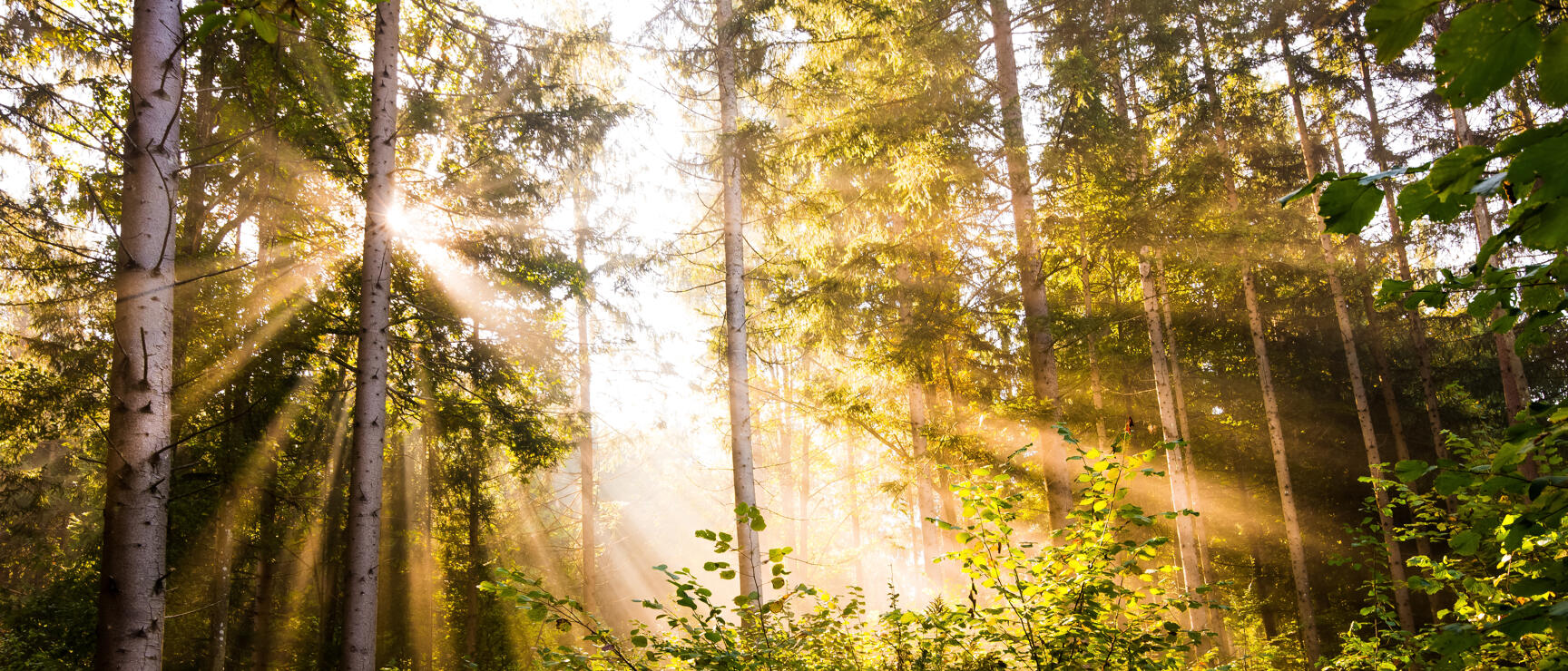
Sunrays breaking through coniferous trees in a green mixed forest with dense undergrowth.
  1. Homepage
  2. Austria's Landscapes
  3. Austria's Forests

Austria's Forests
Forest bathing, forest walks, and hiking between the trees

The scent of moss, birdsong among the trees, light through the canopy: forest bathing, hiking and walking let you experience Austria's forests with all your senses.

Walking through a forest means moving through a world of sounds, scents, light and shifting perspectives. This is exactly what forest bathing is about. The Japanese practice of shinrin-yoku involves immersing yourself consciously in the atmosphere of the forest – with no athletic goal, but with time to look, listen, smell and feel. Austria offers a variety of settings and regions for this: from the Bohemian Forest and the Waldviertel to the Vienna Woods and the mountain forests of the Alps.

If you're after more activity in the forest, you can follow hiking trails or explore themed and adventure paths. In national parks, nature parks and biosphere reserves, guided tours lead to remarkable areas of woodland and offer insights into their wildlife and plants. Some routes run through gorges and moorland, others beneath ancient tree canopies – and every forest has its own story to tell.

Austria's most beautiful forest regions

Almost half of Austria is covered in forest. Between the Bohemian Forest, the Vienna Woods and the stone pine forests of the Nockberge, tree species, altitudes and landscapes change – and so does the experience of the forest.

Did you know …

… how many trees are growing in Austria's forests?

About 48% of Austria’s land area is covered by forest. That’s 4 million hectares of forest.

… how many tree species Austria's forests have?

Spruce leads the way with 49.2% of the forest area, followed by beech with 10.2%. Overall, the share of conifers is falling, while the proportion of broadleaved trees is rising.

… that Austria has a primeval forest?

The Rothwald primeval forest in the Dürrenstein-Lassingtal Wilderness Area in Lower Austria is the largest remnant of primeval forest in the entire Alpine arc. Since 2017, the wilderness area has been part of the UNESCO World Heritage Site 'Ancient and Primeval Beech Forests of the Carpathians and Other Regions of Europe'.

… why deadwood is so important for a forest?

Deadwood provides a habitat for countless forest organisms and is part of the natural nutrient cycle: as it decomposes, nutrients are released, and deadwood also stores water and carbon. Around 20 to 30% of the fungi, lichens, mosses, snails, beetles, birds and mammals found in forests depend on deadwood.

… who owns Austria's forests?

Around 81% of Austria's forest area is privately owned, with the remaining 19% in public ownership. Some 137,000 owners share the privately owned forest between them.

Source: Austrian National Forest Inventory

Outdoor activities in the forest

There's plenty of room to be active among the trees: hiking, trail running and gravel biking on forest tracks, mountain biking on the trails. In winter, snowshoeing and winter walking join in, with yoga and high ropes courses rounding things off.
The forest with all your senses

Forest bathing

Shinrin-yoku translates as 'bathing in the atmosphere of the forest' and comes from Japan. Forest bathing is not about pace, distance or athletic achievement. Instead, your attention turns to what can be sensed between the trees. It can help you step back from the rush of everyday life and settle into the moment for a while.

How does forest bathing work?
Walk slowly through the woods, stop and take in your surroundings attentively: listen to the rustle of leaves, feel moss under your fingers, smell the forest floor, or watch the light shift between the treetops. That turns a walk in the woods into a journey of discovery for the senses.

Beautiful places and guided tours for forest bathing

There are plenty of ways to try forest bathing in Austria: in different regions, at Austria's Hiking Villages, on forest paths, on guided tours and workshops, or combined with a hike.

Why are we drawn to the forest?

The forest engages the senses

Among the trees, everything changes: leaves rustle, the ground gives way underfoot, light falls through the canopy and, depending on the season, the air smells of earth, foliage or resin.

The forest connects us

For centuries, people have used the forest and its resources. Timber provided building material and fuel, and was used for tools and for cooking. To this day, the forest remains part of Austria's culture and everyday history.

The forest is full of impressions

The rustle of leaves, the scent of resin, the texture of different barks, light and shade: on foot, you can see, hear, smell and feel the forest.

The forest sets a different rhythm

On a walk in the woods, the next step isn't dictated by deadlines or screens but by the path, the terrain and your own pace. Sometimes you're crossing soft forest floor, sometimes your eye is caught by an old tree or a clearing.

The forest as a network

Trees respond to their surroundings
Climate, soil, terrain and water supply determine the conditions in which trees grow. The circumstances for individual tree species therefore vary from site to site.

Trees compete
Trees compete for limited resources such as light, water and nutrients – both with trees of their own species and with other species.

Water and temperature shape growth
Temperature and rainfall are among the factors that influence how trees grow. If conditions at a given site change, so can the growth of different tree species.

Tree roots and fungi form partnerships
Many tree roots live in partnership with what are known as mycorrhizal fungi. The tree supplies the fungus with sugars and receives nitrogen and phosphorus, among other nutrients, in return.

Sources: BFW, Thünen-Institut (Links in German only), waldwissen.net

FAQs

Among Austria's most heavily forested regions are the Waldviertel in Lower Austria, the Bregenzerwald in Vorarlberg, the Lungau in SalzburgerLand, the Nockberge Biosphere Reserve in Carinthia and the Silberregion Karwendel in Tirol. From dense mountain forests and expansive stone pine woods to extensive stands of maple, each region offers its own forest experience.

Around 81% of Austria's forest is privately owned – by farming and forestry businesses, companies or private individuals. The remaining 19% or so is in public ownership, managed by the federal government, the provinces and municipalities, including the Austrian Federal Forests.

As a rule, camping in the forest without permission is prohibited in Austria. Anyone wishing to spend the night in a forest must ask the landowner or the forest road operator. Camping without permission can result in substantial fines.

Yes. The Dürrenstein-Lassingtal Wilderness Area in Lower Austria is home to the Rothwald, the largest remnant of primeval forest in the Alps. It has been a UNESCO World Heritage Site since 2017. As the area is strictly protected, access is only possible on guided walks along marked paths.

Spruce is the most common tree in Austria's forests, accounting for around 50% of the forest area, followed by beech with around 10%. Overall, the share of conifers is falling, while the proportion of broadleaved trees is rising.

The forest is a place of peace and relaxation, and a few simple rules help keep it that way. Open fires and smoking are not permitted in the forest; barbecuing is allowed at designated barbecue sites only. Keep dogs on the lead and leave the loud music at home, so that wildlife is disturbed as little as possible. Mountain bikes may only use approved routes. Sticking to marked paths means you avoid trampling plants and habitats off the trail.

You might also like

Discover the Best of Austria

Sign up for our newsletter and enjoy exclusive access to:

  • Insider tips and itineraries for your next trip to Austria

  • Traditional recipes

  • Must-see events and cultural highlights

  • Interesting stories about Austria