Austria by Car and Motorcycle
Find out about traffic rules, e-mobility, speed limits, the Vignette, road toll fees and more.
From gentle rolling hills to impressive Alpine passes, Austria is ideal for exploring by road. Travelling by car or motorbike offers plenty of variety, and the country's dense, well-maintained road network ensures reliable connections. Motorways and expressways require a toll sticker (Vignette), and some routes also charge an additional toll.
Austria is also well equipped for electric mobility: more than 30,000 public charging points support environmentally friendly travel. This makes getting around Austria a smooth and enjoyable experience, combining movement, discovery and convenience.
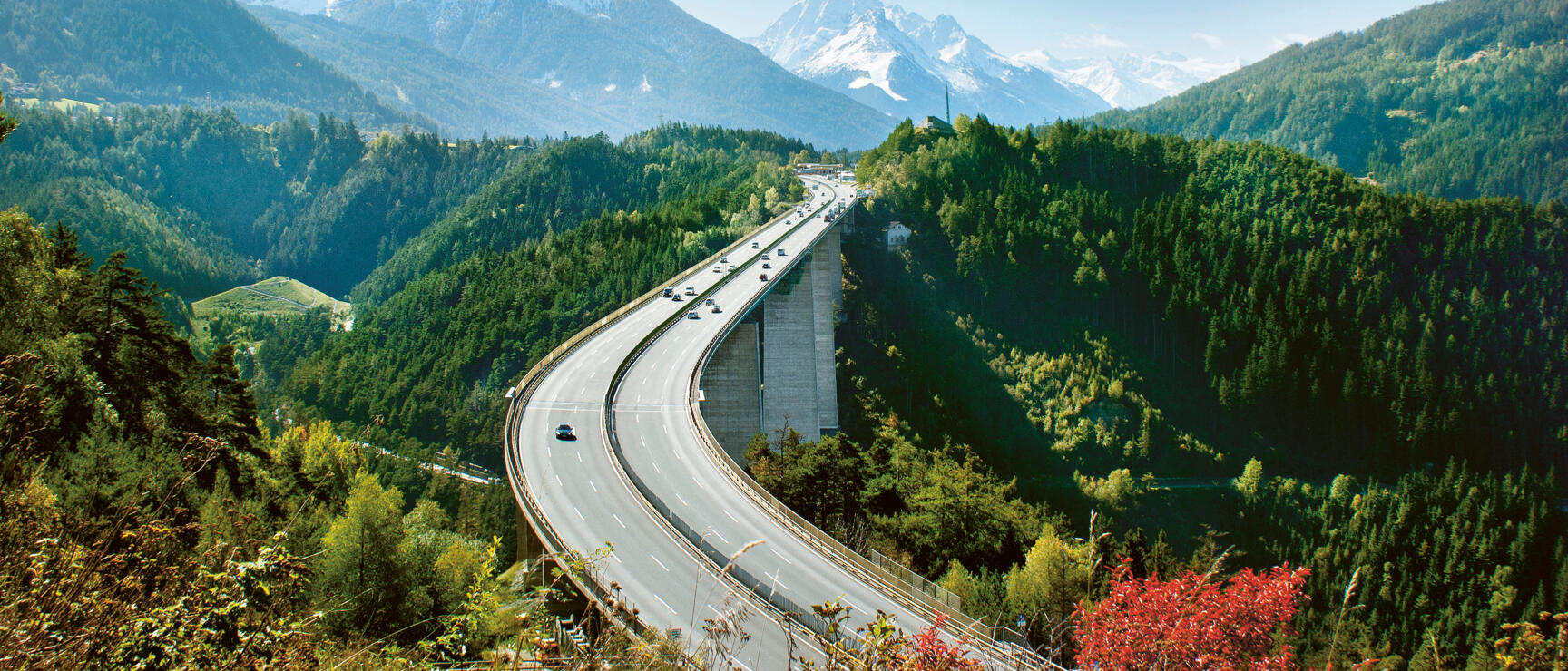
Construction on the new Lueg Bridge
For traffic safety reasons and to reduce the strain on the Lueg Bridge, traffic will be reduced to a single lane in both directions from 1 January 2025. On days with high traffic volumes, a temporary two-lane system will be implemented using a special traffic management setup to minimise long delays and congestion.
Further information
Important notice: The Silvretta High Alpine Road will remain closed for the entire 2026 season.
As an alternative, the Vermunt cable car (including tunnel bus service) will be in operation from 9 August 2025, providing access to the Bielerhöhe from the Vorarlberg side. Further information on the closure can be found here.
The most important traffic regulations
Austria's traffic regulations and road signs generally correspond to those of other European countries.
Attention: In Austria, all motorways and expressways are subject to tolls!
Driving licences from all countries within the European Economic Area and EU member states are recognised in Austria indefinitely and do not need to be converted. Driving licences issued outside the European Economic Area are valid for 12 months from the date of arrival in Austria, provided the holder is at least 18 years old.
Attention: If the driving licence is not written in German, it is only valid in conjunction with an international driving permit or a translation.
Safety regulation on Austria's roads
Wearing seat belts is mandatory in Austria. Children under 14 who are shorter than 150 cm (4.9 ft) may only travel in appropriate child seats. In cars and estates (including minivans), only one child per seat is allowed, and each must be secured according to age and size.
Using a phone while driving is only allowed with a hands-free device that can be operated with one hand and does not interfere with driving.
Motorcyclists must wear helmets, have a vignette, and use dipped headlights during the day.
All drivers must carry a first aid kit, a warning triangle and a reflective safety vest, and be able to present them during a traffic check.
Outside built-up areas, wearing a safety vest is mandatory when stepping onto the road after a breakdown or accident. It is recommended to carry a vest for every passenger.
Drink-driving:
The legal limit is below 0.5 mg alcohol per ml of blood; for provisional licence holders and lorry/bus drivers the limit is 0.1 mg. Violations result in heavy fines and licence confiscation.
When there's a traffic jam
Whilst driving on Austria’s roads, you might notice signs proscribing the so-called "Rettungsgasse" (emergency corridor). This is a clear lane for emergency vehicles that has to be formed right away in case of traffic jams.
On carriageways with two lanes, a lane for emergency vehicles must be cleared between the two existing lanes; on carriageways with more than two lanes it must be cleared between the far-left lane and the lane next to it. This means that all drivers of vehicles in the far-left lane are required to steer their vehicle as far to the left as possible. All other drivers must drive as far to the right as is necessary to clear a lane for emergency vehicles.
Find more information here.
Breakdown or accident in Austria
If you experience a breakdown or accident on Austria's roads, stay calm and act carefully.
First, switch on the hazard lights and, if possible, stop the vehicle at the side of the road. Before getting out, put on your safety vest – it is mandatory. In poor visibility or on unclear road sections, place a warning triangle at a safe distance.
If the vehicle can no longer be driven, the ARBÖ breakdown service or the ÖAMTC emergency service can help around the clock – free of charge for members, and available for a fee for everyone else.
After an accident, provide first aid and call the emergency services. On motorways, emergency call points are located every 1.5 km and can be used to request assistance.
For property damage, those involved must exchange details; in the case of personal injury, the police must always be notified.
The most important emergency numbers
Maximum speed limits
Under optimal traffic conditions and if not otherwise indicated, the following maximum speed limits apply in Austria:
For cars, motorbikes and caravans up to 3,5t
Within town limits: 50 km/h (approx. 31 mph)
On the open road: 100 km/h (approx. 62 mph)
On expressways: 100 km/h resp. 130km/h (approx. 62 mph resp. 80 mph) - Please observe the respective speed limit.
On motorways: 130 km/h (approx. 80 mph)
For more information and other types of vehicles please check here.
Important: In wet, snowy or low-visibility conditions, adjusting your driving is essential.
Winter equipment for vehicles
From 1 November to 15 April, winter equipment is mandatory in Austria. Vehicles must be fitted with winter tyres on all four wheels or with snow chains on at least two drive wheels.
Winter tyres are only considered winter equipment in Austria if they have the "M+S" marking and a tread depth of more than 4 mm. This also applies to all-season tyres and studded tyres.
Snow chains are only permitted when the road is completely or almost completely covered with snow or ice. Carrying snow chains is not mandatory, but it is recommended for trips into high-alpine regions. If the traffic sign "snow chains required" is displayed, all vehicles must fit snow chains on the drive wheels. Therefore, please check the weather conditions and current traffic service reports before setting off.
Up-to-date traffic information
Traffic information from across Austria, as well as from the main routes in neighbouring countries, is reported every half hour by the radio station "Hitradio Ö3". In the event of acute danger – for example, wrong-way drivers – the radio programme is immediately interrupted and a broadcast is made on all other ORF radio stations. Traffic reports can be made around the clock by calling 0800 600 601 or the short dial number *300 (free for all of Austria). The radio station broadcasts mainly in German.
All information is also available online through the Ö3 traffic service or the ASFINAG traffic reports. Additionally, the automobile club ÖAMTC offers traffic forecasts, a congestion calendar, and other useful information.
Gas stations in Austria
At petrol stations, unleaded regular petrol with 91 octane, Euro-Super (unleaded petrol with 95 octane), and Super Plus (unleaded petrol with 98 octane), as well as diesel, are available.
The sale of leaded petrol is prohibited in Austria, but an additive is available at petrol stations for vehicles without a catalytic converter.
Up to 10 litres can be carried tax-free in a reserve canister. Current fuel prices, electric charging stations, and further tips can be found on the ÖAMTC website.
E-mobility in Austria
E-mobility has long been part of everyday life in Austria. The network of charging stations is continuously expanding – from cities to Alpine regions. Across the country, charging points ensure that travelling by electric car remains convenient and sustainable, whether at a motorway fast-charging station or a hotel charging point.
Here, you'll find an overview about stations to charge your electric vehicle in Austria:
Parking in Austria
In many Austrian cities, short-term parking zones limit how long you may park. The permitted duration is shown on a sign at the start of each zone and applies to the entire area.
Parking is usually regulated with a paper ticket or digital app. Tariffs and maximum times vary by municipality, often between 1.5 and 3 hours.
For longer stays, use car parks or park-and-ride facilities, which are well connected to public transport.
Pay attention to special zones such as resident-only areas or loading zones, as violations may result in fines.
Motorcycles often have separate rules, and designated parking spaces are frequently free of charge.